What if your entire life—every memory, every emotion, every moment of joy or despair—could be plotted on a graph? Not metaphorically, but literally? In World Lines, EB Diamond takes that unsettling idea and turns it into the foundation of a novel that is as scientific as it is philosophical. At the center of this bold speculation is the theory proposed by Professor Nathan Sloan: that human beings, like all matter, trace a path through space-time—a world line—and that this path defines not only where we are, but who we are.
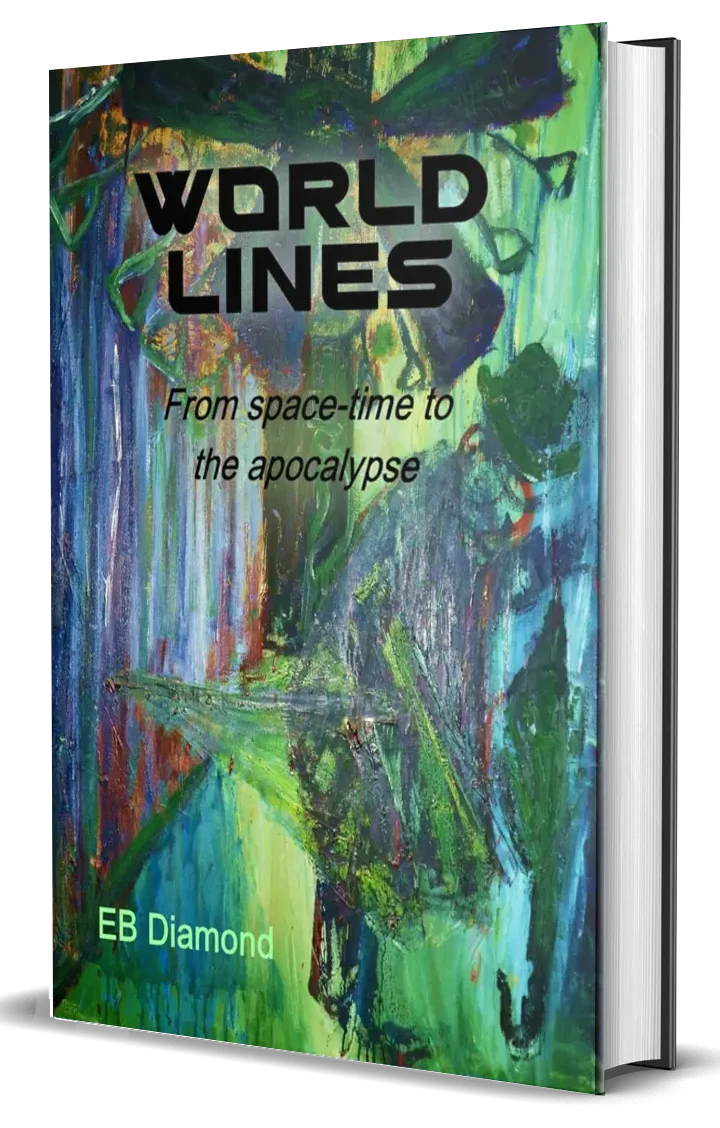
This idea isn’t pure fantasy. In physics, a world line is a real concept: it represents the history of an object in spacetime, a continuous curve that maps out its movement. For most scientists, this is a tool to understand events on cosmic or quantum scales. But for Sloan—and by extension, Diamond—it becomes something far more personal. If people can be plotted like particles, does that mean our identities are just data? Or does it mean that the graph itself holds deeper truth?
Sloan’s work suggests that we may be more than bodies living in time. We may be expressions of geometry, echoes in a four-dimensional universe. The implications are staggering. Identity becomes not a stable fact, but a trajectory. Choice becomes not just moral, but directional. When someone dies, perhaps they don’t vanish—they simply arc away along a different coordinate.
This isn’t reductionist. On the contrary, Diamond’s treatment of this theory elevates human life. Rather than diminish us to lines on a page, she invites us to see those lines as art—each life a unique curve, each moment a point of significance. In one haunting scene, Sloan reflects on the loss of his wife, Jean, not as a final end but as a deviation, a departure from a shared path. It’s a painful thought, but also a poetic one: that love itself might exist as overlapping world lines, briefly intertwined.
The elegance of this idea extends to the story’s structure. The novel’s narrative isn’t linear—it loops, echoes, and refracts. Just as in the real-world diagrams Sloan uses to illustrate his theory, the story arcs across multiple versions of events, from the neutrino anomalies at the mine to Darien’s passage through unstable dimensions. We begin to see that identity in World Lines is never singular. Characters have doubles. Histories have mirrors. A man might be a scientist in one line and a mystic in another.
So what are we? Are we the sum of choices, or the path they create? World Lines doesn’t provide easy answers. Instead, it allows readers to sit with the tension: between math and mystery, between soul and science.
This interpretation of human experience through physics is not just novel—it’s profoundly moving. It asks readers to reimagine memory, grief, ambition, and even death as part of a larger equation. An equation not of emptiness, but of possibility.
In an era where identity is questioned, where meaning is elusive, and where time feels fragmented, World Lines offers a radical but oddly comforting notion: maybe we are equations. But if so, we are equations drawn by the universe itself—elegant, complex, and infinitely unique.
And if we’re lucky, maybe our world lines will intersect with others in just the right way to feel, even for a moment, that we understand something greater than ourselves.
Get Your Copy On Amazon: https://www.amazon.com/dp/B0DCWTW3RR/