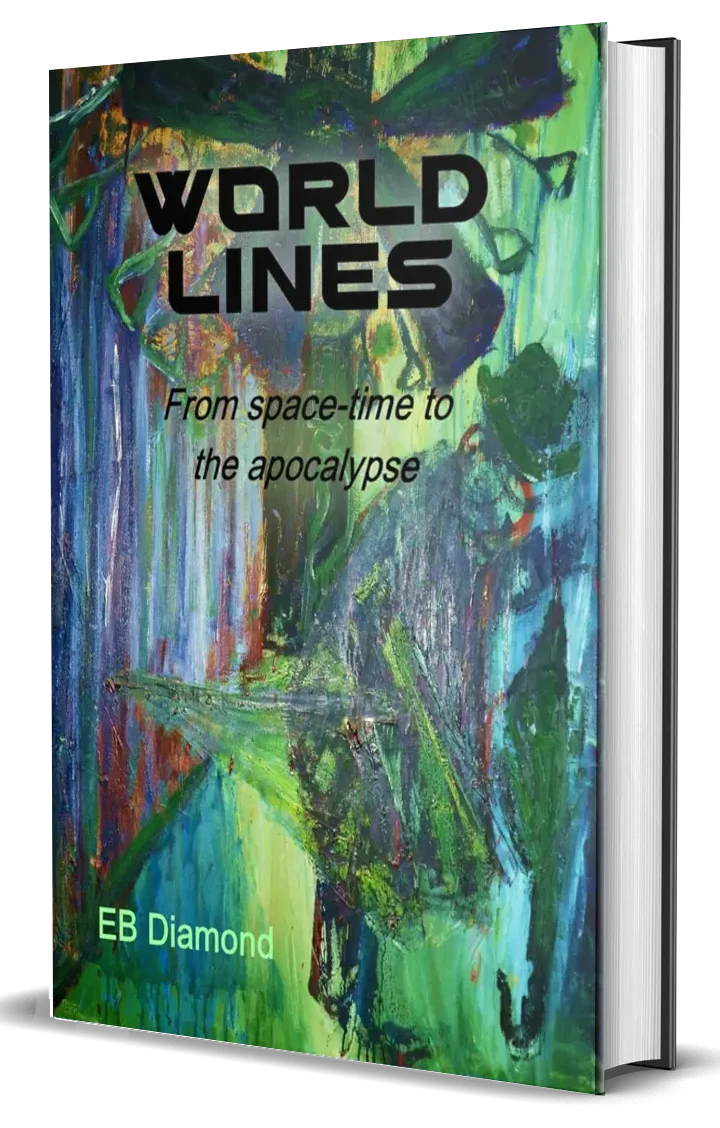
In World Lines, EB Diamond gives us a version of the apocalypse that doesn’t explode on the screen—but creeps in subtly, invisibly, in the form of neutrino spikes, shifting tectonic plates, and rumors of alternate dimensions. It’s not a global fireball—it’s a question.
Can we escape disaster? Should we?
And more importantly—how do we prepare when the rules of time and space might shift beneath our feet?
The Science of Survival… Sort Of
The novel’s central figure, Professor Sloan, is trying to solve a mystery: why did some civilizations seem to vanish without a trace? His answer: they didn’t die—they escaped, shifting their world lines at just the right moment.
This isn’t just sci-fi flair. It’s a deep metaphor for our modern longing to avoid catastrophe—climate collapse, pandemics, war, societal decay. We see the warning signs, and like Sloan, we wonder if there’s a backdoor, a secret route, a somewhere else.
World Lines suggests there might be… but not one we can access with bunkers or bug-out bags.
Escape as an Idea
In the novel, escape isn’t physical—it’s dimensional. If the right alignment of space, time, and gravitational force comes together, people may be able to shift realities entirely. It’s a thrilling concept, but also one loaded with irony: the idea that some people might be positioned to escape, and others not, based on knowledge, location, or sheer luck.
Sound familiar?
In a world where the wealthy prepare luxury shelters while the vulnerable face rising seas, World Lines becomes eerily relevant. It doesn’t give us answers, but it helps us ask better questions.
The Professor’s Prediction
Professor Sloan isn’t just trying to escape—he’s trying to warn. He’s the thinker no one listens to, the academic dismissed for being too speculative. And that’s where fiction hits closest to home: how often do real-world scientists sound alarms, only to be ignored?
Fiction like World Lines shines light on our tendency to disbelieve disaster until it’s too late—and reminds us that truth often starts out sounding like science fiction.
No Simple Solutions
Unlike many apocalypse stories, World Lines doesn’t offer a savior or a last-minute plan. Instead, it leans into uncertainty. The book says, in essence: “We don’t know what’s coming. But maybe we should start looking at the lines.”
That’s both chilling and liberating. The future can’t be predicted—but it can be explored.
What Fiction Prepares Us For
Can fiction help us prepare for catastrophe? Yes—because it trains us to think creatively, to ask “what if?”, and to understand that even the most outlandish theories may one day become headlines.
But it also says no—because escape isn’t easy, and sometimes there is no escape.
All we can do is listen. Think. Prepare our minds.
Final Thought
World Lines doesn’t offer survival kits. It offers perspective. It challenges readers to consider a broader definition of preparedness—one that includes awareness, curiosity, and flexibility.
In a world full of unknowns, maybe the best preparation is learning how to think beyond the lines.
Get Your Copy On Amazon: https://www.amazon.com/dp/B0DCWTW3RR/