In EB Diamond’s World Lines, science is not portrayed as a cold, clinical discipline—it is an art form, a way of drawing maps through dimensions both physical and existential. The scientists in this novel don’t simply test hypotheses or run experiments. They chart the unknown. They draw meaning from the cosmos, turning data into stories and numbers into myth. They are, in every sense, cosmic cartographers.
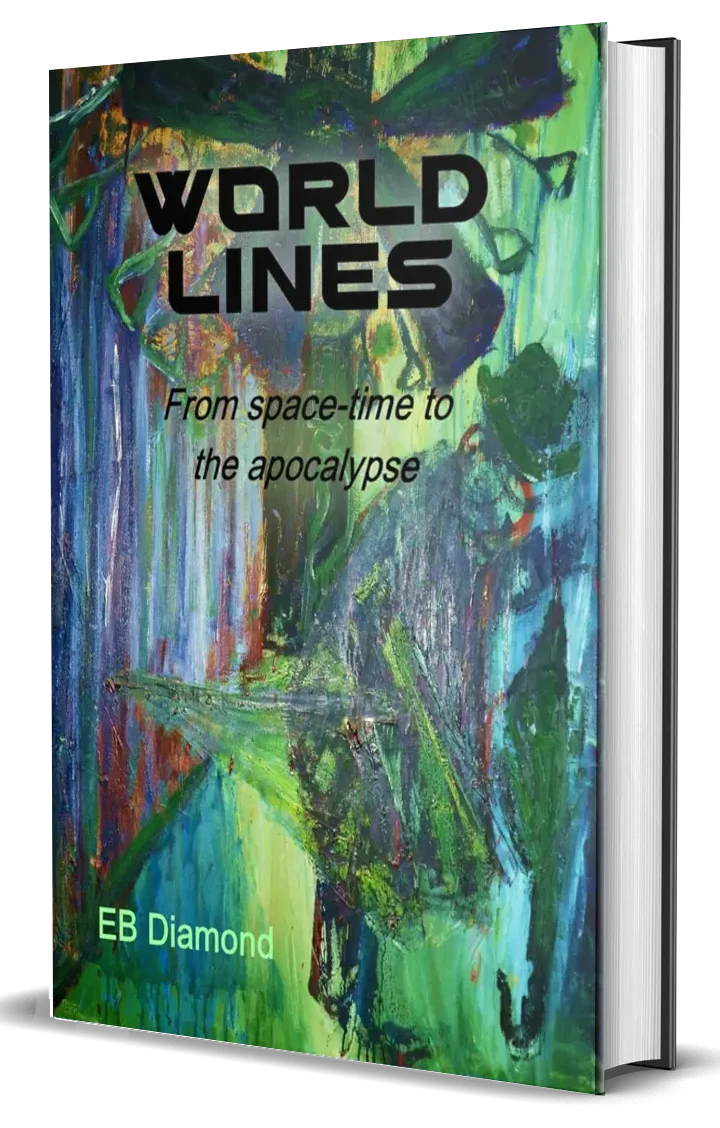
At the heart of the novel is Professor Nathan Sloan, a physicist who sees the universe not just as a mechanism, but as a mystery—one that must be interpreted as much as understood. His theory of “world lines” proposes that human lives trace paths through space-time, and that these paths can curve, branch, or even jump between dimensions. While this begins as a scientific exploration, it soon becomes an intensely personal journey, especially after the death of his wife Jean and the disappearance of his assistant.
Sloan isn’t merely recording reality—he’s trying to reconstruct it, piece by piece, like a narrative with missing pages. His diagrams, equations, and lectures become modern-day mythologies. Each graph he plots is a new chapter, each anomaly a character whose presence demands interpretation.
This storytelling function is shared by others in the novel, including Marco Spelling, the flamboyant promoter of the neutrino mine. Though often treated as a comic figure, Spelling also embraces a storyteller’s role—one that blurs science and spectacle, blending physics with prophecy. Even the robotic TD1 and TD2 serve this purpose in their own way, offering poetic commentary on the unfolding events and echoing the role of jesters or chorus members in classical drama.
But perhaps the most poignant example of the scientist-as-storyteller is the dual character of McBarrister and the Fisherman. In one version, he’s a detached academic; in another, he’s a mythic guide. Both forms offer knowledge, but they do so through different languages—one analytical, the other symbolic. Both remind us that stories aren’t just about what happens—they’re about how we understand what happens.
This framing of scientists as narrative-makers challenges a common stereotype in fiction: that scientists are emotionless, logical, and uninterested in meaning. World Lines offers the opposite view. In this world, science is as much about belief as observation. The researchers don’t just look for facts—they interpret them, shape them, and ultimately use them to navigate a universe that defies easy explanation.
It’s a beautiful metaphor for the human condition. Just as explorers once drew maps of lands they couldn’t fully traverse, Sloan and his colleagues sketch theories of dimensions they can only partly enter. Their work is speculative, yes—but it’s also deeply human, driven by grief, love, hope, and the need to make sense of what cannot be seen.
In World Lines, EB Diamond reframes science as something far richer than data collection. It becomes a tool for mapping not just reality, but experience. The scientists in this novel aren’t just discoverers of fact—they are interpreters of fate. They tell the stories that help us survive the unknown.
And in doing so, they remind us that every charted line—every theory, every hypothesis, every story—is really a search for meaning. A line, after all, must start somewhere. And it’s the storyteller’s job to decide where it leads.
Get Your Copy On Amazon: https://www.amazon.com/dp/B0DCWTW3RR/