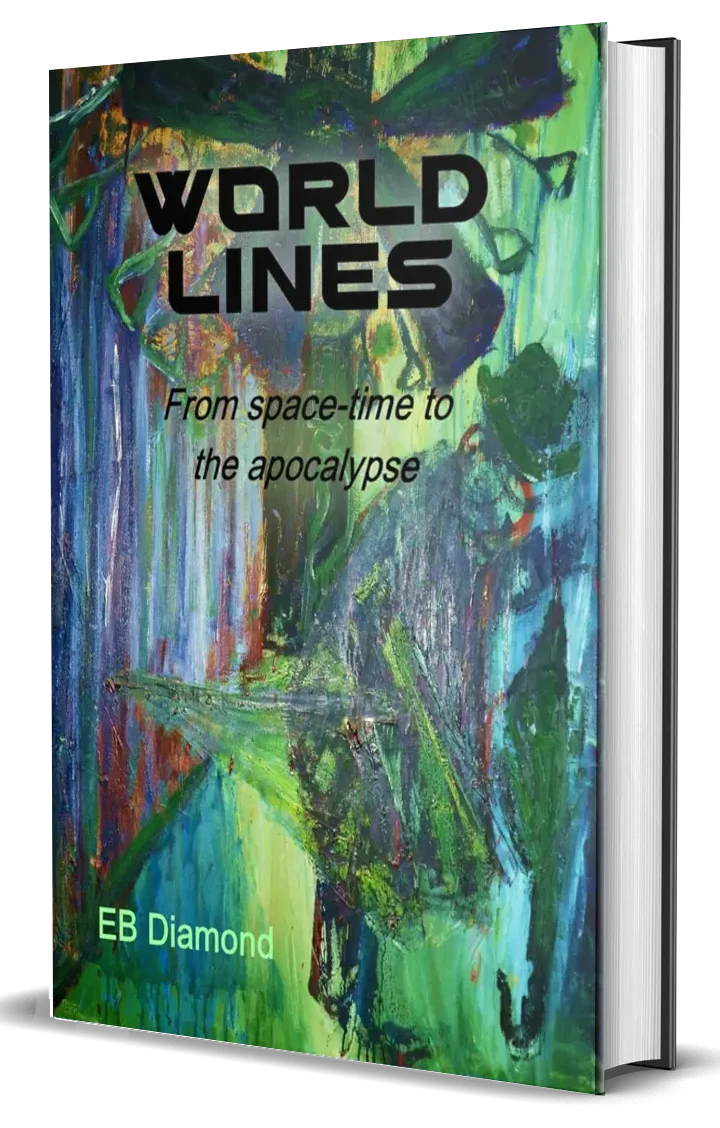
In EB Diamond’s World Lines, the rules of reality are not broken—they’re reimagined. The novel dives headfirst into the paradoxical and the irrational, embracing a kind of dream logic where robots quote poetry, sacred sites align with quantum physics, and the absurd becomes a pathway to deeper understanding. It’s a world where nonsense makes sense—not because it follows traditional rules, but because it reveals truths that lie beyond them.
From the first pages, the story signals that it operates on multiple planes: physical, philosophical, and symbolic. Characters don’t just traverse landscapes—they move between dimensions. They don’t just process grief—they displace it across alternate timelines. And crucially, they do so guided not solely by logic, but by riddles, intuition, and oddities that feel like fragments of a dream.
Consider the characters TD1 and TD2, the lovable and strangely profound workers at the neutrino mine. At face value, they’re comic relief. They stumble through scientific processes with childlike misunderstandings and irreverent commentary. Yet as the story progresses, their seemingly nonsensical observations begin to hold weight. They ask the questions others won’t. They spot anomalies hidden by expertise. They are fools in the literary sense—the ones who can speak truth to power by pretending not to understand.
Then there’s the robot RCR23, who defies genre conventions entirely. She’s a humanoid, yes, but she’s also emotionally attuned, philosophically curious, and capable of expressing awe and affection. Her dialogue includes moments of unexpected depth—she marvels at human connection, repeats cryptic lines, and reflects on existence in ways that mirror ancient koans or Zen parables.
Even the narrative structure mirrors dream logic. Time is not linear, events unfold with echo and distortion, and reality bends around metaphysical ideas rather than hard chronology. The mountain known as Mt. Aurora, for instance, acts not just as a physical place but as a symbolic fulcrum—much like the enchanted forests or glass castles of fairy tales. It’s where transformation happens, often with no scientific rationale—but with total emotional clarity.
And what about the Fisherman? His cryptic appearances and sage-like detachment echo mythical guides like Charon or Merlin, but instead of answers, he offers questions that open doors. In a conventional novel, this might frustrate. But in World Lines, it feels right. The irrationality is the point. The universe is not neat. It is strange, poetic, and recursive.
This blend of irrational truth is part of what gives World Lines its distinct voice. Diamond doesn’t shy away from paradox—she leans into it. In doing so, she opens space for the ineffable, the spiritual, and the surreal. Readers are invited to let go of the need for explanation and instead experience the story as one might experience a dream: letting patterns emerge, meanings echo, and emotions linger.
It’s a daring literary move. But it works—because the heart of World Lines isn’t about explaining the universe. It’s about feeling it, through characters who ask irrational questions in a rational world. Through portals that open without reason. Through laughter that becomes revelation.
In a time where fiction is often forced to choose between realism and fantasy, EB Diamond gives us something rare: a narrative that chooses intuition, and reminds us that some truths only make sense when logic falls away.
Get Your Copy On Amazon: https://www.amazon.com/dp/B0DCWTW3RR/