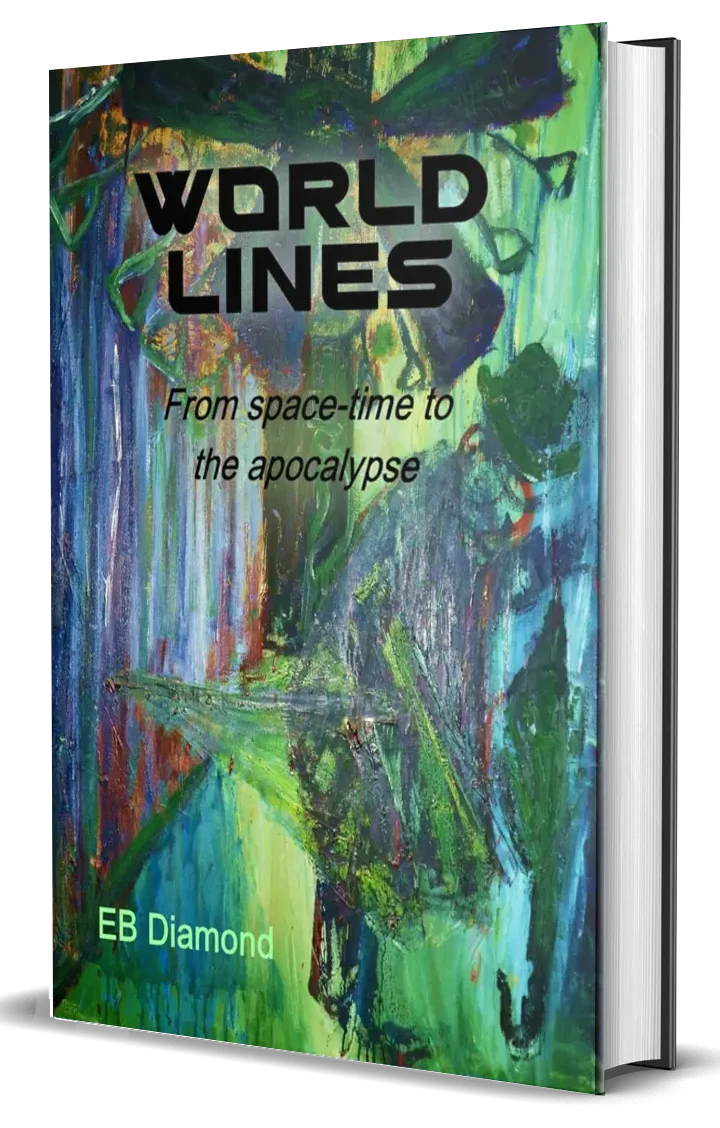
One of the boldest ideas at the center of EB Diamond’s World Lines is the suggestion that catastrophic cosmic events—like a supernova—might do more than just light up the sky or obliterate nearby planets. They might actually rupture space-time itself, creating portals into other dimensions.
It’s a speculative premise, but not entirely untethered from reality. In modern astrophysics, supernovae are known to release tremendous amounts of energy, emitting not just light and radiation, but a flood of neutrinos—nearly massless subatomic particles that can pass through planets, stars, and even you without leaving a trace. In World Lines, the appearance of unusual neutrino readings becomes an early warning sign that something massive—and possibly interdimensional—is on the horizon.
Professor Sloan’s theory isn’t just a response to neutrino data; it’s a vision of cosmic cause and effect. What if gravitational shockwaves from a collapsing star could twist the geometry of space-time? What if, at certain intersecting points—like tectonic convergence zones or neutrino-rich regions—this distortion could tear the veil between dimensions?
The neutrino mine at the heart of the story is built on this speculative frontier. Positioned near a tectonic fault and experiencing strange neutrino spikes, it becomes more than a scientific outpost—it becomes a watchtower, scanning the skies not just for disasters, but for doorways.
And while the book builds these ideas through fiction, it draws from real scientific possibilities. Physicist Kip Thorne has explored the concept of wormholes—tunnels through space-time that, in theory, could allow faster-than-light travel or movement between dimensions. Theoretical constructs like the Einstein-Rosen Bridge suggest that with enough energy (such as that from a stellar explosion), it might be possible to distort space-time in ways we don’t yet understand.
In World Lines, EB Diamond builds on these theories to pose a chilling—and thrilling—possibility: What if the universe has warning systems embedded in it? What if neutrinos are not just byproducts of stellar collapse, but precursors to dimensional instability? And what if a supernova doesn’t just end a star’s story—but starts another one in a different dimension?
This adds an emotional weight to the science. The characters are not merely observing distant phenomena—they are living in their consequences. When Richard Watson disappears during an experiment, it isn’t just a scientific failure—it might be a dimensional shift triggered by energy convergence. When Sloan’s wife dies, his search for understanding isn’t just about grief—it’s about the possibility that she might still exist somewhere else.
The speculative leap from supernova to portal isn’t about abandoning science. It’s about expanding it. It invites readers to ask not just “What is possible?” but “What haven’t we yet imagined?”
By blending astrophysics with human drama, World Lines offers a compelling vision of the universe as both a lab and a labyrinth. A place where massive cosmic events are not just background noise, but catalysts for new realities.
So could a supernova open a portal?
In EB Diamond’s universe, it already has.
Get Your Copy On Amazon: https://www.amazon.com/dp/B0DCWTW3RR/