In World Lines by EB Diamond, time isn’t a straight line—and neither is memory. As the novel unfolds across multiple dimensions and theoretical world lines, it becomes clear that memory in this universe is not confined to the brain. It’s a presence. A resonance. A ghost that travels across timelines, lingering in the air like a forgotten song.
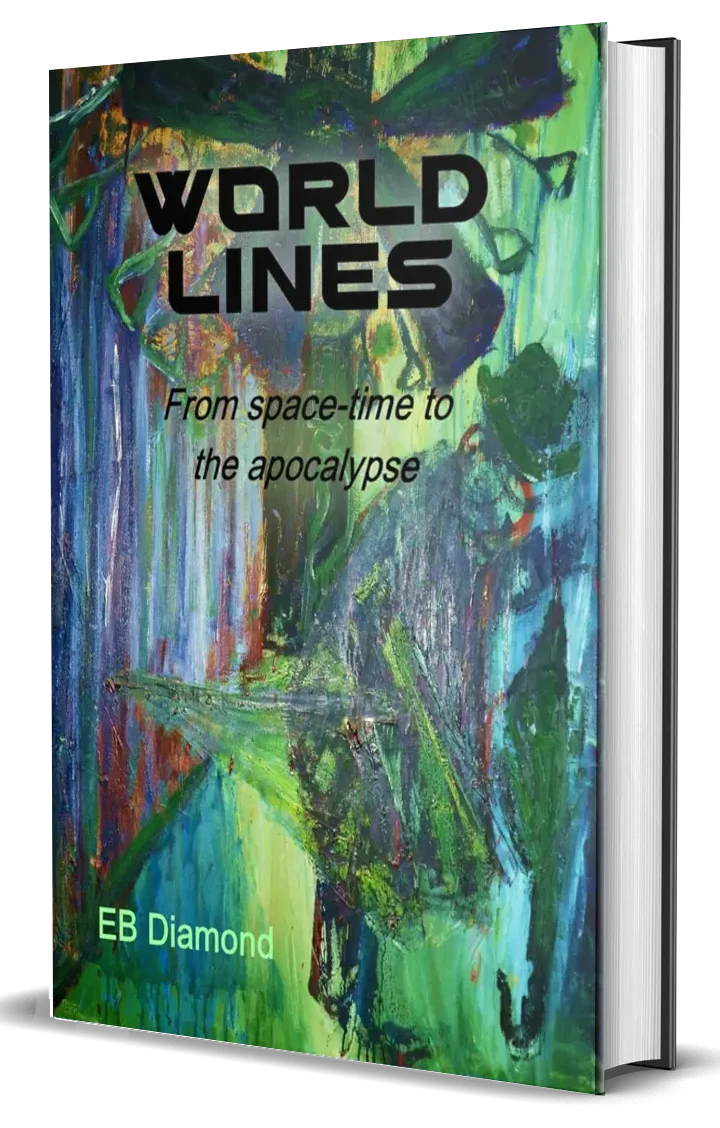
At the center of this meditation is Professor Nathan Sloan, a physicist driven by personal loss and cosmic inquiry. The death of his wife, Jean, is not just a tragedy—it is a mystery that transforms into obsession. Sloan’s grief compels him to explore whether death is truly the end or simply a dimensional departure. And it’s this line of questioning that gives memory its central role in the narrative.
Sloan theorizes that individuals can shift along their world lines—paths that trace their existence through space and time. But if this is true, then it opens a philosophical and emotional paradox: Can memory transcend a single timeline? Can echoes of our lives follow us into other realities?
The novel never answers these questions definitively, but it explores them with lyrical depth. Darien, Sloan’s daughter, finds herself in unfamiliar territories—geographically and existentially—while memories of her father, of Richard Watson, and of her own place in the world remain strangely intact. At moments, she senses presence where there should be absence. It’s not a haunting in the traditional sense, but a cross-dimensional whisper.
And then there are the Alternates—beings who are versions of people from different world lines. They appear familiar, yet changed. Their memories sometimes overlap with those of the protagonists. These shared or fractured recollections suggest that memory is interdimensional, not confined to the biology of the brain, but embedded in the structure of space-time itself.
This concept finds its strongest symbolic expression in places like Mt. Aurora and the Reflective Pool—locations that act as convergence points between dimensions. Characters often experience visions, recollections, or sudden emotional clarity in these places. It’s as if memory is activated not just by the mind, but by the environment itself—a spatial echo of a life once lived, now looping back.
There’s something deeply human in this portrayal. Grief, after all, is a kind of memory. It’s the presence of absence, the echo of a moment we can’t return to. In World Lines, EB Diamond transforms that feeling into a metaphysical principle. Memory doesn’t just linger—it traverses. It follows the world lines like current through a wire, sparking recognition in unexpected places.
What elevates this beyond pure speculation is how it’s grounded in character. Sloan isn’t just a man of science—he’s a man of memory. His equations aren’t abstract; they’re tributes to what he’s lost and hopes to recover. Darien isn’t just navigating new terrain—she’s retracing emotional lines drawn long ago.
And through it all, memory in World Lines becomes more than just a narrative device. It becomes a bridge—between timelines, between people, between what was and what might be. In a story about dimensional collapse and cosmic instability, memory becomes the one force that remains intact. Or, at least, returns.
EB Diamond’s vision of memory is not nostalgic, but expansive. It challenges us to think of memory not as something we own, but something we share—across lives, across choices, and possibly across worlds. And in doing so, it suggests a comforting possibility:
Maybe we are never truly forgotten. Maybe we are just remembered somewhere else.
Get Your Copy On Amazon: https://www.amazon.com/dp/B0DCWTW3RR/