Time travel. Well, the possibility of traveling between times is fascinating. From famous movies like Back to the Future to unique and contemporary science-fiction books like World Lines: From space-time to apocalypse, and theories and explanations, like the latest quantum teleportation, time travel has long been a topic or subject of debate.
But the question remains the same. Could it be possible?
Since a lot of people are intrigued by the idea of traveling between eras, changing the past or seeing the future before it’s due, no one has ever demonstrated the kind of time travel we have been seeing in science fiction or proposed a method of sending a person through significant periods of time that wouldn’t destroy them on the way. While there have undoubtedly been numerous online speculations and claims about time travel, there has yet to be a solid case that strongly supports the claim and possibility of time travel.
If we imagine time as physically jumping between the past, present, and future within a single timeline, we run into scientific obstacles. For example, Einstein’s Theory of Relativity tells us that time is not absolute – that it stretches and compresses depending on speed and gravity. This indicates that time behaves differently throughout the universe. If an astronaut traveled near the speed of light to another planet or to the cosmos and returned to Earth, they would have aged significantly less than those who remained on Earth.
Here’s where things get tricky. Wormholes! They are proposed as shortcuts through spacetime. However, no one has proven their existence or figured out how to use them. Even if we could, the famous “grandfather paradox” arises, which states that if you went back in time and prevented your grandfather from meeting your grandmother, your father would not have existed. This means that you would not exist in the present. If so, how could you have traveled back in time in the first place?
While there are many theories and speculations about time travel, if we were ever able to have the ability to travel in time, it is going to be amazing. Imagine what we could be possibly doing. Would any of us want to warn the present of us from something?
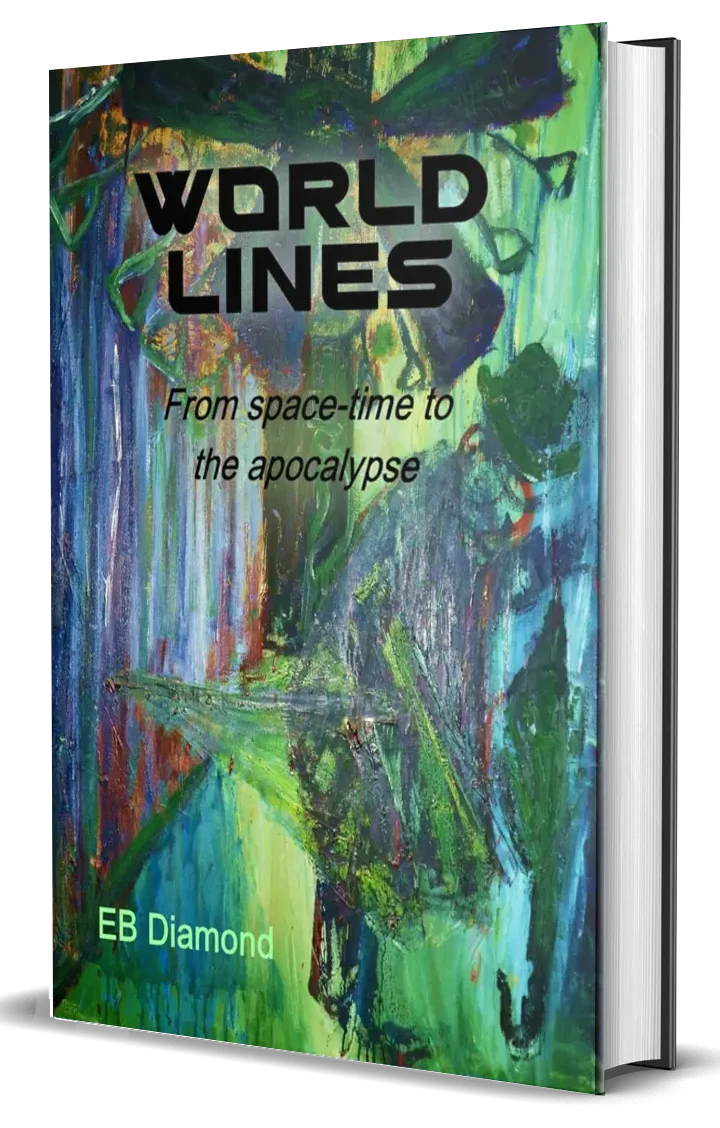
World Lines: From space-time to apocalypse offers a fresh perspective on the concept and possibility of time travel. What if time travel isn’t about moving backward or forward in one timeline but about shifting across parallel worlds where different choices have led to different outcomes? This idea, rooted in quantum mechanics and the multiverse theory, suggests that every decision we make spawns a new branch of reality within our parallel version of existence.
Instead of traveling through time, what if we could step into another version of our world? One where history played out differently?
World Lines: From Space-Time to Apocalypse is a quirky, thought-provoking adventure set in the present day, where the very fabric of time is more fluid than we imagine. Most people follow a straight “world line” from birth to death, but some, the “alternates,” experience time differently. They can loop, repeat, or exist in multiple places at once. This eccentric cast of characters, including a Scottish fisherman, an Air Force pilot, and a professor obsessed with immortality, find their lives intertwined amidst abductions, earthquakes, and breaches in the time-space continuum. As they converge on a mysterious mountain, preparing for a neutrino mine, they will face consequences that will significantly change their lives. Blending humor, philosophical musings, and a touch of the absurd, World Lines explores the boundaries between science and faith, the rational and the nonsensical, creating a unique reading experience that will leave you questioning the very nature of time and destiny.
Get your copy on Amazon: www.amazon.com/dp/B0DCWTW3RR/.
That being said, the Many-Worlds Interpretation of quantum mechanics suggests that infinite parallel universes exist, each following its own trajectory. If we could develop the right technology, something akin to what the Professor theorizes, perhaps we wouldn’t need to build a time machine at all. We would simply step sideways into an alternate version of reality.