If you’re looking for a science fiction novel that challenges your mind, stirs your spirit, and gives your imagination a workout, look no further than World Lines by EB Diamond.
This is not your standard space opera or dystopian thriller. Instead, it’s a genre-defying fusion of speculative physics, philosophical reflection, and satirical wit—all wrapped in a gripping adventure across time, space, and consciousness.
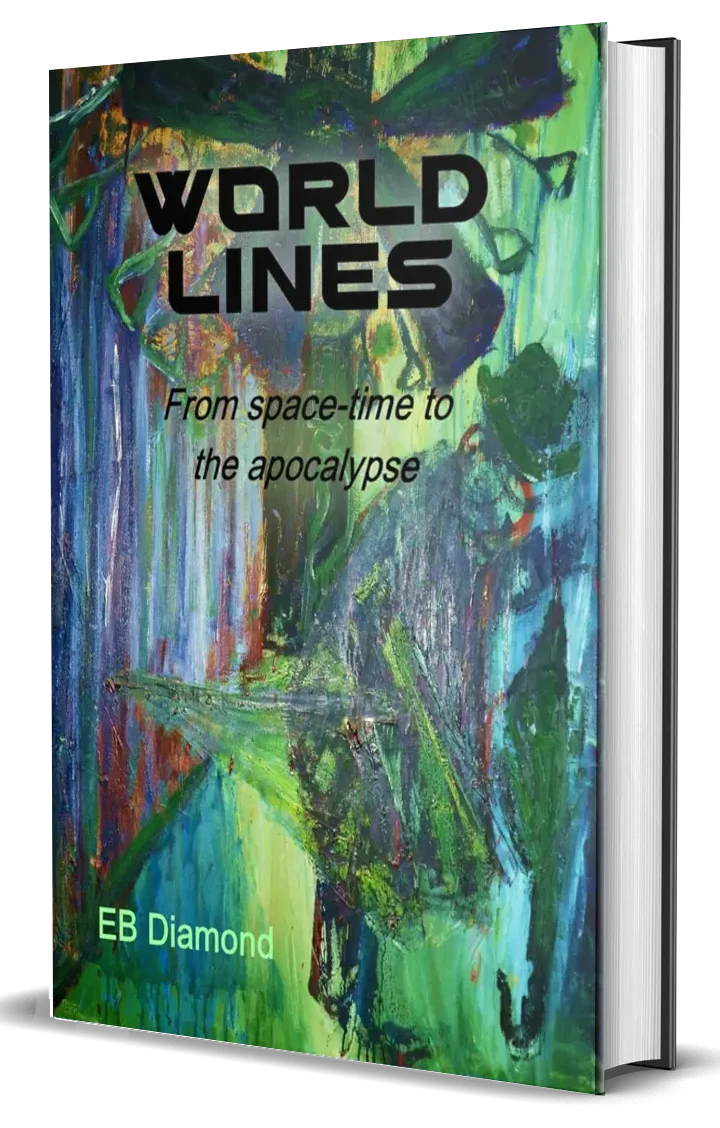
The Big Ideas: Space-Time and Soul Travel
At the heart of World Lines is a single, elegant premise: that our lives can be plotted on a space-time graph as “world lines”—paths we take through the universe. Most people move forward in one direction. But what if some could deviate?
Enter the “Alternates”—a group of mysterious beings who can shift their world lines, effectively escaping death, dodging disaster, and slipping through dimensions. The book’s protagonist, a physicist known only as the Professor, becomes obsessed with proving this phenomenon and decoding how ancient civilizations may have already discovered the secret.
It’s a theory that blends Einstein and esoterica, mixing hard science with metaphysical awe.
Tectonic Plates and Portal Points
One of the novel’s most fascinating concepts is the idea that certain locations on Earth—intersections of tectonic plates, gravitational anomalies, or ancient sites like the Great Pyramid of Giza—are “vulnerable” positions on the space-time grid. These are not just earthquake zones. They might be portals—gateways between dimensions where one’s world line can bend or shift entirely.
The Professor believes that these points were known to the ancients, who built structures to mark and preserve them. Far from superstition, Diamond suggests that monuments, myths, and religious rituals may actually be maps—tools to help future generations navigate their own world lines.
The Soul of the Story
But World Lines isn’t just an intellectual exercise. It has heart.
At its emotional core is the Professor’s desperate search to recover his daughter, a pilot lost under mysterious circumstances. His quest is not just about science—it’s about hope, grief, and the universal desire to reconnect with lost loved ones.
The story also explores friendship, loyalty, and the strange ways science and belief often intertwine. Diamond never shies away from the emotional cost of knowledge or the human desire to find meaning in chaos.
Humor, Satire, and Pop Culture Smarts
Despite its depth, World Lines doesn’t take itself too seriously. It’s full of clever puns, absurd dialogue, and characters that could’ve walked out of a Lewis Carroll reboot. There’s a brilliant balance between the profound and the playful, making even the densest ideas feel accessible and engaging.
Readers will laugh, question, and reflect—all in the same chapter.
Who Should Read World Lines?
- Sci-fi lovers who crave original ideas and grounded world-building.
- Physicists or STEM enthusiasts who enjoy theory with a narrative twist.
- Philosophical thinkers who ponder destiny, death, and the nature of reality.
- Casual readers who love a good adventure, richly drawn characters, and a bit of quirky charm.
Final Thought
World Lines is a novel for curious minds and open hearts. It’s for readers who wonder what lies beyond the next moment—not just in science, but in soul.
Time, tectonics, and the soul—it all comes together here.
If you’ve ever wondered if fiction can truly expand your mind while pulling at your heart, World Lines belongs on your reading list.